

› Forums › General Melanoma Community › Why Is Interleukin-2 so important for mounting an immune response?
- This topic has 4 replies, 2 voices, and was last updated 14 years, 6 months ago by
jim Breitfeller.

- Post
-
- September 26, 2011 at 11:49 pm
The T-cell-specific cell-surface receptors CD28, CTLA-4, ICOS and PD-1 are important regulators of the immune system. CD28 potently enhances those T-cell functions that are essential for an effective antigen-specific immune response, and the homologous CTLA-4 counterbalances the CD28-mediated signals and thus prevents an otherwise fatal overstimulation of the lymphoid system. PD-1 engagement can prevent ICOS but not CD28 costimulation. The inability of ICOS costimulation to override PD-1 inhibition is directly related to the low IL-2 levels it induces upon its engagement.
The T-cell-specific cell-surface receptors CD28, CTLA-4, ICOS and PD-1 are important regulators of the immune system. CD28 potently enhances those T-cell functions that are essential for an effective antigen-specific immune response, and the homologous CTLA-4 counterbalances the CD28-mediated signals and thus prevents an otherwise fatal overstimulation of the lymphoid system. PD-1 engagement can prevent ICOS but not CD28 costimulation. The inability of ICOS costimulation to override PD-1 inhibition is directly related to the low IL-2 levels it induces upon its engagement. ICOS Costimulation requires IL-2 and can be prevented by CTLA-4, PD-1 engagement. With the CD3/CD28 blocked downstream at the P13K and the Akt pathways, the T-cell is activated but the proliferation and survival of T-cells/immune response is terminated.
A picture is worth a thousand words.
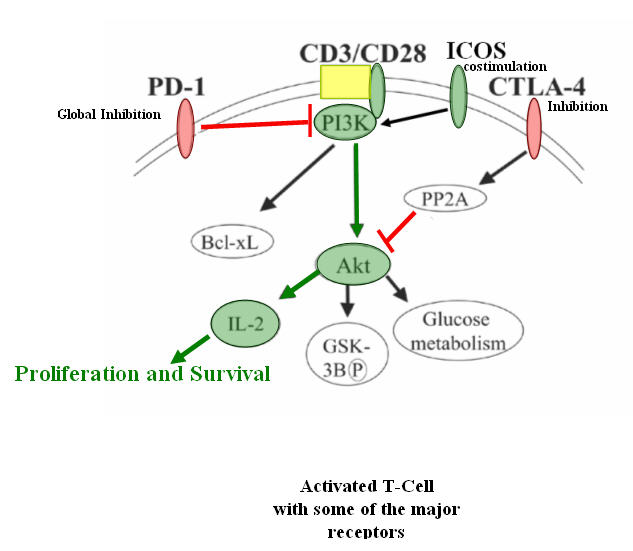
Based on the above model, Downstream of the CD3/CD28 signaling the co-inhibitors down modulate the P13/Akt signaling. Signaling via CD28 is required for optimum IL-2 production, cell cycle progression, and survival. CD28 is constitutively expressed on naive CD4+ T cells is slightly upregulated after T cell activation.
The CTLA-4 and the PD-1 expression increase over time in Melanoma patients. This is why it is so very hard to eradicate Melanoma in the late stage IV.
To counteract the inhibition, one can use Antibodies to block the suppressive signaling coming from the CTLA-4 and PD-1. This is where Yervoy (Anti-CTLA-4) and Anti-PD-1 come into play. So if you can do a therapy with a systematic approach, you may be able to beat Melanoma.
It is now known, that IL-2 can down regulate PD-1 receptor so you might not need to do Anti-PD-1 therapy. Or you might do anti-PD-1 instead of IL-2 therapy to cut down the harsh effects of the IL-2 therapy. It is now known that the T-cell activation/immune response needs IL-2 to produce a robust immune response.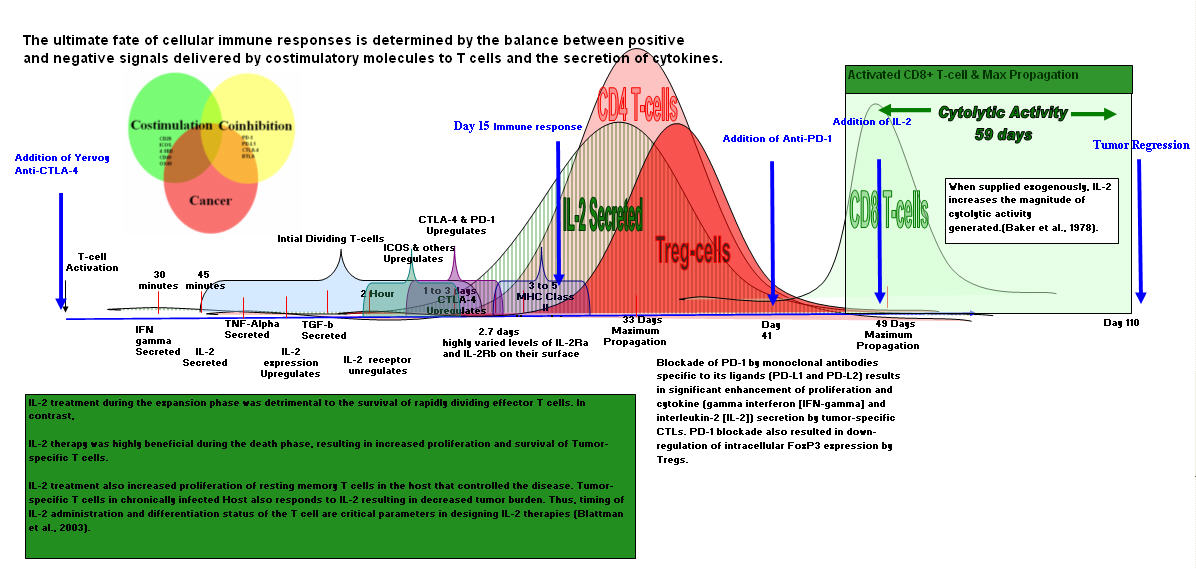
Best regards,
Jimmy B

- Replies
-
-
- September 26, 2011 at 11:58 pm
Hi Jimmy,
God Bless you for all the time you take to try & help us all understand this terrible disease melanoma.
There might be an opening for me in a anti-pdL-1 trial???
In your opinion, do you think anti-pdL-1 is as effective as a anti-pd1.
Thanks
An
-
- September 26, 2011 at 11:58 pm
Hi Jimmy,
God Bless you for all the time you take to try & help us all understand this terrible disease melanoma.
There might be an opening for me in a anti-pdL-1 trial???
In your opinion, do you think anti-pdL-1 is as effective as a anti-pd1.
Thanks
An
-
- September 27, 2011 at 12:16 am

I hope this helps.
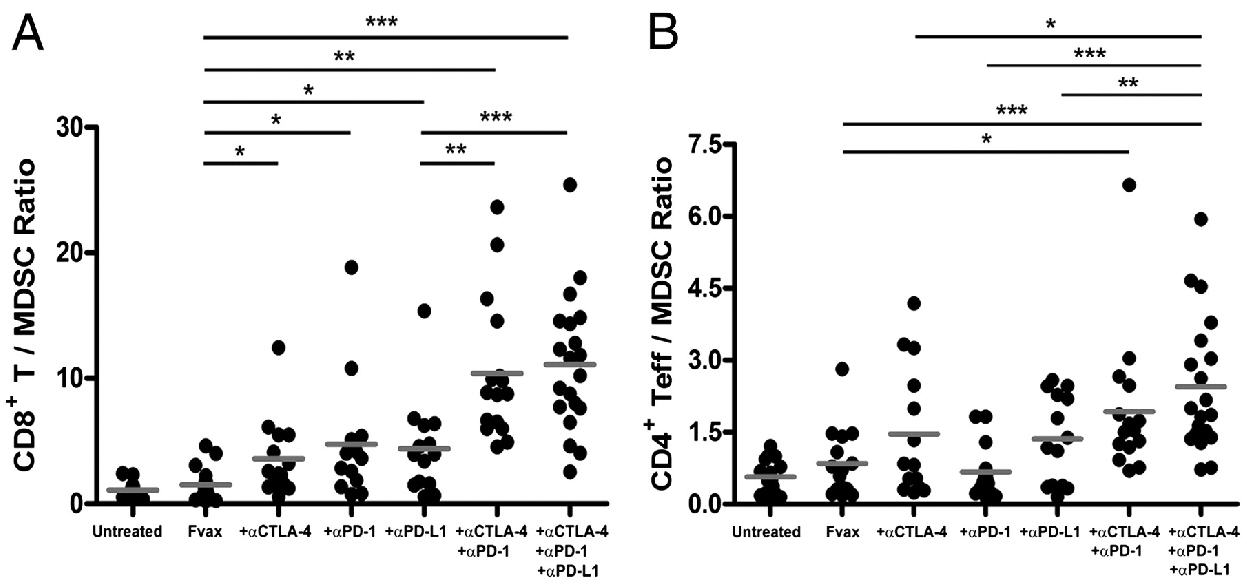
There not a lot of Information on PD-L1 therapy. So here is a graph with it broken down by CD8+ T-cells (They become CTLs that attack the tumor and CD4+ helper cells that crossprime the CD8+ T-cells.
-
- September 27, 2011 at 12:16 am
I hope this helps.
There not a lot of Information on PD-L1 therapy. So here is a graph with it broken down by CD8+ T-cells (They become CTLs that attack the tumor and CD4+ helper cells that crossprime the CD8+ T-cells.
-


- You must be logged in to reply to this topic.